If you work in pharma, you hear IND, NDA, ANDA, and BLA all the time. They sound alike. But each one does a very different job.
Think of them as four applications to the US FDA. Together, they move a product from the lab to the US market. One lets you test a drug in people. The others let you sell it.
So let’s go through them one by one.
The Four Pathways in One Look
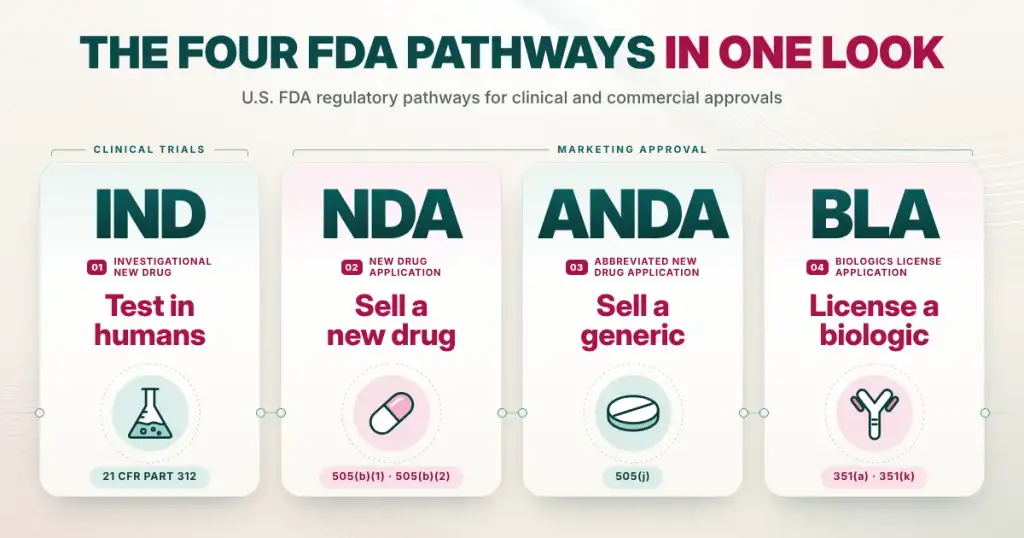
IND: Permission to test in humans
Let’s start with the IND, or Investigational New Drug application. Before a new drug or biologic is given to people, the sponsor files an IND. It is the gateway to clinical trials. It is not a marketing approval.
So what goes into an IND?
Mainly preclinical data from lab and animal studies, information on how the product is made, and the clinical protocol, which is the plan for the trial. Here’s an important point. After FDA receives the IND, the sponsor has to wait 30 days. If the FDA does not pause the study, known as a clinical hold, the IND comes into effect, and the trial can begin. Until then, even patient recruitment has to wait. The rules for INDs sit under 21 CFR Part 312.
NDA: Approval to market a new drug
Once the trials are done, what comes next?
For a new drug, it is the NDA, or New Drug Application. The NDA asks the FDA for approval to market the drug in the US. It has to show that the drug is safe and effective for its intended use. It has to show that the benefits outweigh the risks. It also has to show that manufacturing keeps the drug’s identity, strength, quality, and purity intact. The data collected under the IND becomes part of the NDA.
There are two routes here, both under Section 505 of the FD&C Act.
505(b)(1) is the full route. It is typically used for new molecular entities, meaning brand-new active ingredients. The company submits its own full safety and efficacy studies.
505(b)(2) is the middle route. It suits new formulations, doses, or uses of drugs we already know. The company runs some studies itself. For the rest, it can rely on published literature or on the FDA’s earlier findings for a listed drug.
ANDA: the route for generics
Now let’s talk about generics. This is where the ANDA, or Abbreviated New Drug Application, comes into the picture.
Why is it called “abbreviated”?
Because a generic company generally does not need to repeat the preclinical and clinical studies. The original drug has already proven its safety and efficacy. Instead, the generic has to show two things. First, it is the same as the Reference Listed Drug (RLD). Second, it must be bioequivalent. In simple words, it must perform in the body just like the original.
ANDAs fall under Section 505(j) of the FD&C Act.
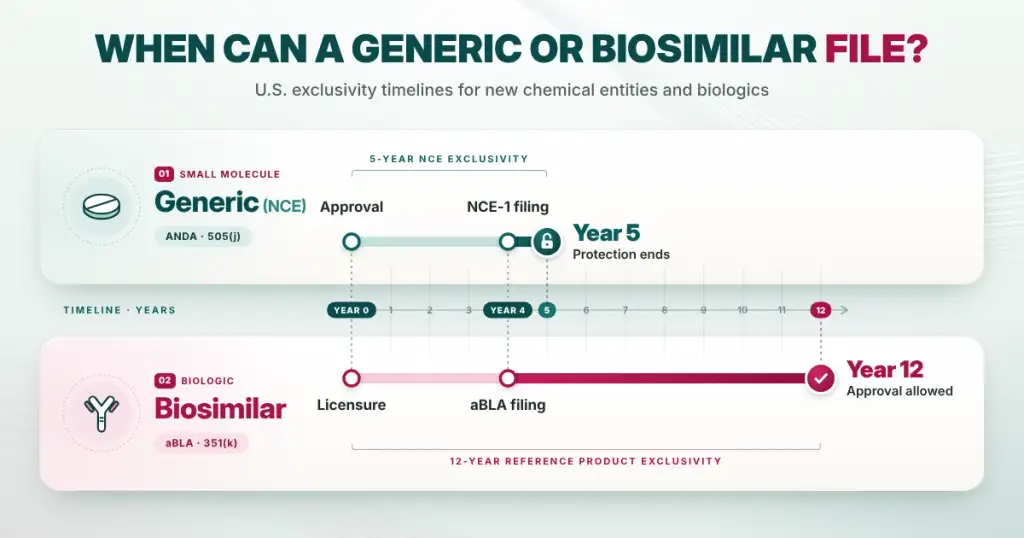
Timing matters here. A drug with a brand-new active ingredient is called a new chemical entity (NCE). It gets five years of protection after approval. But a generic company can file its ANDA after four years if it challenges the brand’s patents. That four-year mark is the NCE-1 date. An ANDA filed then is often called an NCE-1 filing.
BLA: the route for biologics
So far, we have talked about chemical drugs. Biologics take a different path. Biologics are made from living systems. Think vaccines, monoclonal antibodies, therapeutic proteins, blood products, and cell and gene therapies. They are larger and harder to characterize than chemical drugs.
For these, the sponsor files a BLA, or Biologics License Application. Notice the word “license”. A BLA leads to licensure, not just approval. It falls under Section 351 of the Public Health Service (PHS) Act. The product has to be shown as safe, pure, and potent.
Most BLAs are reviewed by the FDA’s Center for Biologics Evaluation and Research (CBER).
The BLA has two routes as well.
351(a) is for original biologics. The sponsor submits full data on safety, purity, and potency.
351(k) is for biosimilars and interchangeable products. Here, the sponsor shows that its product is highly similar to a licensed US reference product. Since this is shorter than a full BLA, it is often called an abbreviated BLA, or aBLA.
Timing matters here too. An aBLA filing can go in four years after the reference product is licensed. But approval can come only after 12 years. This route came in with the Biologics Price Competition and Innovation Act of 2009.
When can a generic or biosimilar file?
All Four at a Glance
| Pathway | Used for | Key Evidence |
| IND (21 CFR 312) | Starting clinical studies in humans | Preclinical data, manufacturing information and clinical protocols |
| NDA 505(b)(1) | New drugs, typically new molecular entities | The applicant’s own full safety and efficacy studies |
| NDA 505(b)(2) | New formulations, doses or uses of known drugs | Own studies plus literature or FDA’s prior findings for a listed drug |
| ANDA 505(j) | Generic drugs | Sameness and bioequivalence to the RLD |
| BLA 351(a) | Original biological products | Full data showing safety, purity and potency |
| BLA 351(k) | Biosimilar and interchangeable products | Biosimilarity to a licensed US reference product |
This is a simplified overview. Requirements vary by product, so always check current FDA guidance.
What connects them: reference products
Here’s something people often miss. Most of these pathways depend on a reliable reference product.
- An ANDA needs the RLD for bioequivalence studies.
- A 505(b)(2) uses a listed drug for bridging studies.
- A 351(k) needs the US-licensed reference product for comparative studies.
- IND trials often need comparator and standard-of-care drugs for control arms.
If that product is late or difficult to find, the whole filing plan slows down.
That is where Spring Bio Solution comes in. We support pharmaceutical companies, CROs and research organizations with comparator drug sourcing, RLD sourcing and clinical trial supply. Planning a filing? Talk to our team.
FAQs
What is the difference between an IND and an NDA?
An IND lets you test a drug in people. An NDA asks for approval to sell it. The IND comes first, and its data later becomes part of the NDA.
What is the difference between an NDA and a BLA?
An NDA is for chemical drugs. A BLA is for biologics, which are made from living systems. NDAs fall under the FD&C Act. BLAs fall under the PHS Act.
Why is an ANDA called “abbreviated”?
A generic company generally does not repeat the clinical studies. It only shows that its drug is the same as the RLD and works the same way in the body.
What is an NCE-1 filing?
A new chemical entity gets five years of protection after approval. A generic company can file its ANDA after four years if it challenges the brand’s patents. That early filing is called an NCE-1 filing.
What is an aBLA filing?
n aBLA is the abbreviated BLA filed for a biosimilar. It can go in four years after the reference product is licensed. Approval can come only after 12 years.